The Ansoff matrix: a practical guide for growth strategy
In 1994, Quaker Oats paid $1.7 billion for Snapple. Twenty-seven months later, they sold it for $300 million. The acquisition looked sensible on paper. Quaker already knew beverages from Gatorade. But the two businesses had almost nothing in common. Quaker had misjudged how far it was moving from what it knew.
The Ansoff matrix is the simplest useful framework for thinking about growth strategy. It asks one question: where is your growth going to come from? And it gives you four possible answers based on two variables: are you selling existing products or new ones, and are you selling to existing markets or new ones? The further you move from what you already know, the higher the risk.
The origin and the idea
Igor Ansoff was born in Vladivostok, Russia, in 1918. His family emigrated to the United States in 1936, settling in New York. He trained as a mathematician and physicist at Stevens Institute of Technology, earned a PhD in applied mathematics from Brown University, and spent nearly a decade at the RAND Corporation working on weapons acquisition strategy for the U.S. Air Force.
In 1957, he joined the Lockheed Aircraft Corporation, where he eventually rose to Vice President of Planning and led the Diversification Task Force. He was literally the person responsible for figuring out how Lockheed should grow beyond its core business. That same year, he published “Strategies for Diversification” in the September-October issue of the Harvard Business Review, ideas he would later expand into the book Corporate Strategy (1965), the first text devoted entirely to the subject.
The timing mattered. The 1950s and 1960s were the era of the American conglomerate, and executives were diversifying with more financial ambition than analytical rigor. Harold Geneen at ITT acquired roughly 350 companies in more than 80 countries, growing the company from $765 million in sales to $17 billion. Royal Little at Textron acquired so many unrelated businesses that the company left the textile industry entirely. Charles Bluhdorn at Gulf+Western acquired roughly 80 firms in six years. As Walter Kiechel writes in The Lords of Strategy, antitrust enforcement at the time meant companies couldn’t easily acquire competitors, which pushed growth-hungry executives toward unrelated businesses:
“The results were frequently disastrous.”
Much of the logic was financial engineering: acquire companies with lower price-earnings ratios than your own, add their earnings to yours, and watch your stock price climb. The strategy worked until it didn’t. Many of these conglomerates collapsed or were broken up in the 1980s.
Ansoff argued that diversification decisions needed analytical discipline, not just financial cleverness. As he wrote in the original article:
“Diversification generally requires new skills, new techniques, and new facilities… it represents a distinct break with past business experience.”
His framework mapped growth options along two dimensions: the product (existing or new) and what he called the “mission” (the market: existing customers and needs, or new ones). The further a company moves from what it already knows along either dimension, the more risk it takes on.
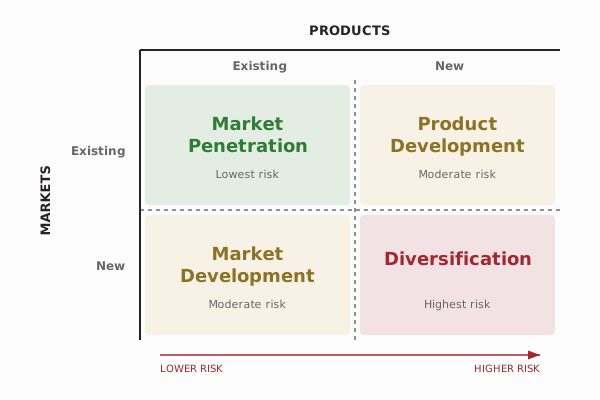
The matrix has four quadrants:
- Market penetration. Existing products, existing markets. Sell more of what you already sell to the customers you already serve. Lowest risk because you’re operating in familiar territory on both dimensions.
- Product development. New products, existing markets. Create something new for customers who already know and trust you. Moderate risk because you understand the customer but not yet the product.
- Market development. Existing products, new markets. Take what you already make and sell it somewhere new, whether a different geography, customer segment, or channel. Moderate risk because you understand the product but not the new market.
- Diversification. New products, new markets. Build something you’ve never built for customers you’ve never served. Highest risk because you’re operating with the least knowledge on both dimensions.
Why the risk gradient matters
The matrix looks almost too simple to be useful. But the value is in what it reveals about how companies actually behave when they chase growth.
Amazon: all four quadrants, sequentially
Amazon is the clearest modern example of a company that has systematically moved through every quadrant, roughly in order of increasing risk.
Market penetration came first. From 1995 to about 2000, Amazon focused almost entirely on selling more books to more online shoppers. One-click ordering, customer reviews, and personalized recommendations. One product category, one market, and relentless optimization.
Product development was next. Starting in 1998, Amazon began selling music, DVDs, electronics, and eventually everything. Same customers (online shoppers), new product categories. The Kindle in 2007 was product development in a more literal sense: an entirely new device for their existing book-buying audience.
Market development followed. International expansion into the UK and Germany (1998), Japan (2000). Amazon Marketplace opened the platform to third-party sellers, reaching new customer types. Amazon Business later targeted enterprise buyers. Same products and platform, new segments, and new geographies.
Diversification was the boldest move. AWS, launched in 2006, was a completely new product (cloud computing infrastructure) sold to a completely new customer (software developers and enterprises). It had almost nothing in common with the retail business. AWS hit a $100 billion annual revenue run rate in early 2024 and is now Amazon’s most profitable division.
The sequence matters. Each move built on capabilities and cash flow from the previous one. Amazon didn’t jump straight to diversification. It earned the right to take bigger risks by mastering the lower-risk quadrants first.
Quaker-Snapple: $1.7 billion for 27 months
Quaker Oats is the cautionary tale of what happens when a company misjudges how far it’s moving from what it knows.
In 1994, Quaker acquired Snapple for $1.7 billion, flush from its success with Gatorade. The thinking seemed reasonable: Quaker understood beverages, and Snapple was a fast-growing brand. But Quaker’s beverage expertise was in mass-market distribution through grocery chains and stadiums. Snapple had built its following through small independent stores and quirky grassroots marketing. The two companies had different distribution networks, different brand identities, and different customer relationships. It wasn’t really product development. It was diversification disguised as adjacency.
Quaker tried to merge Snapple into its Gatorade distribution system. The grassroots brand identity disappeared under corporate marketing. Pepsi and Coca-Cola launched competing products. In March 1997, after just 27 months of ownership, Quaker sold Snapple to Triarc Beverages for $300 million, a loss of $1.4 billion. That works out to roughly $1.6 million lost per day of ownership.
CEO William Smithburg and President Philip Marineau both left the company. The company was eventually acquired by PepsiCo in 2001. Triarc, meanwhile, restored the grassroots distribution model and sold Snapple to Cadbury Schweppes for $1.45 billion in 2000.
The Ansoff matrix makes the mistake visible in hindsight. Quaker thought it was making a moderate-risk move (new beverage product, existing market). It was actually making a high-risk diversification play (different product, different market, different distribution, and different brand strategy). Getting the classification right matters because it determines how much risk you’re actually taking on.
Starbucks: the discipline of staying in the boring quadrant
Starbucks is an interesting counter-example because so much of its growth has come from market penetration, the quadrant most executives find unexciting.
Howard Schultz’s growth strategy for decades was: more stores, closer together, in the same markets. Open a Starbucks on one corner, then another three blocks away. Increase visit frequency through the loyalty program. Raise average ticket size with food items and larger sizes. None of this was new products or new markets. It was relentless optimization of existing products in existing markets.
When Starbucks ventured into other quadrants, the results were mixed. The company acquired Teavana, a specialty tea retailer, for $620 million in 2012 (diversification into a different product and different retail format). By 2017, all 379 Teavana stores were closed, with Starbucks taking a $102 million write-down. A partnership with Kraft for grocery store distribution (market development through a new channel) ended in arbitration, costing Starbucks $2.76 billion to terminate.
The most successful non-penetration move has been market development into China, now Starbucks’ second-largest market. But even that is the same product and experience adapted for a new geography, the lowest-risk form of market development.
The lesson: market penetration often has more upside left than companies realize. The instinct to chase growth through new products and new markets is strong, but the math frequently favors doing more of what already works.
How to run the analysis
Map your current growth initiatives
Start by listing every growth initiative your company or team is pursuing. Be specific. “Grow revenue” isn’t an initiative. “Launch product X in market Y” is.
Plot each one on the matrix. Be honest about whether a product is truly “existing” or different enough to count as new. Similarly, be honest about markets. Selling to a new customer segment in the same geography might be market development, not penetration.
Check the balance
Most companies discover one of two patterns:
Over-indexed on penetration. All initiatives are about optimizing the existing business. Revenue growth is decelerating and the team knows they need something new but keeps defaulting to incremental improvements. The risk isn’t that any single initiative fails. It’s that the company becomes vulnerable to disruption because it never invested in new capabilities.
Over-indexed on diversification. Multiple new-product, new-market bets are running simultaneously. Each one sounds exciting in isolation. Together, they represent an enormous amount of risk and capital deployed where the company has the least expertise. This is the more dangerous pattern because the failures tend to be expensive.
A healthy growth portfolio usually has a base of market penetration initiatives generating near-term cash, a few product or market development bets in the middle, and at most one or two diversification plays.
Sequence the risk
The Amazon example illustrates the most important practical lesson: sequence your growth from low risk to high risk. Use penetration and single-axis moves to build the cash flow and capabilities that fund diversification.
Companies that jump straight to diversification without mastering their core business usually fail. The exceptions (Amazon’s bet on AWS, Google’s bet on Android) tend to be companies with overwhelming cash flow from a dominant core business. They earned the right to take the risk.
Pressure-test the “new” label
The most common analytical error with the Ansoff matrix is classifying something as “new” when it’s actually a variant of something existing. A line extension (new flavor of the same product) isn’t really product development. Selling to a slightly different customer segment in the same geography isn’t really market development.
Conversely, some things that look like minor extensions are bigger strategic moves than they appear. When Netflix went from licensing content to producing original series, that looked like a natural evolution. But it was actually a shift from distribution (their core competency) to content creation (an entirely different business), which placed it firmly in product development territory.
If you get the classification wrong, you’ll underestimate the risk and under-resource the effort.
Where the framework breaks down
The Ansoff matrix has the same limitation as most 2x2 frameworks: it simplifies a continuous spectrum into binary categories. “New” versus “existing” isn’t a clean divide. John Dawes at the University of South Australia published a paper identifying two logical problems: if a new product is truly new to the firm, it often takes the firm into a new market simultaneously, which blurs the line between product development and diversification. And the binary classification of “new” versus “existing” is too crude to capture what is really a continuous spectrum. Is selling a premium version of your product to the same customer base penetration or product development? Reasonable people will disagree.
Henry Mintzberg at McGill University waged a more fundamental critique in a published exchange with Ansoff in the Strategic Management Journal in 1990-91. Mintzberg argued that rational planning frameworks like Ansoff’s misunderstand how strategy actually works. The best strategies, he contended, are often emergent, arising from adaptation and learning rather than from top-down analysis. Ansoff responded that Mintzberg was attacking a strawman, that strategic management had evolved well beyond its 1960s formulations. The debate was never settled, but Ansoff became his own sharpest critic later in life. He acknowledged that his planning frameworks could lead managers into what he called “paralysis by analysis,” a term he coined to describe organizations that overthink strategy instead of acting on it.
The matrix also doesn’t account for competitive dynamics. A market penetration strategy sounds low-risk, but if your market is being disrupted by new technology, doubling down on existing products in existing markets might be the riskiest thing you can do. Kodak’s market penetration in film was “low risk” right up until it wasn’t.
And like the BCG matrix, the Ansoff matrix doesn’t tell you how to execute. It tells you what kind of move you’re making, but the actual work of entering a new market or developing a new product requires much deeper analysis. The matrix is a starting point for thinking about growth, not a substitute for a full strategic framework.
How to think about it
The Ansoff matrix’s real contribution is making risk visible. Every growth initiative carries risk, but teams rarely talk about the type of risk explicitly. Are we taking product risk (we don’t know if this will work)? Market risk (we don’t know if these customers want it)? Or both?
When you plot your growth portfolio on the matrix and see that every exciting initiative sits in the diversification quadrant, that’s a signal to step back. When everything is market penetration and revenue growth is slowing, that’s a signal to step forward.
The framework doesn’t make the decision for you. But it makes the trade-off clear, which is what every useful consulting framework should do. The best question to carry with you: are we taking this risk because we’ve earned the right to, or because we’re bored with what’s working?