
The BCG growth-share matrix: a practical guide for portfolio strategy
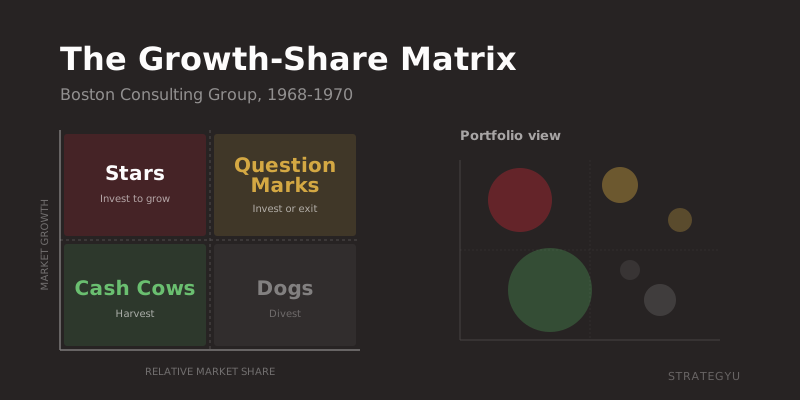
The BCG growth-share matrix might be the most famous single slide in the history of business strategy. Consultants who later went to Bain & Company called it “the million-dollar slide.” The labels alone (stars, cash cows, dogs, question marks) are so sticky that people remember them years after business school.
But most people learn the textbook version: four quadrants, a label for each, and done. The real history, documented in Walter Kiechel’s The Lords of Strategy, is worth knowing because it shows how the matrix came together not as a flash of insight but over several years of client work, by people figuring things out as they went.
Personally, I never used it much, as I spent most of my time in operations, supply chain, and talent & organizational change strategy in my time in consulting. On top of that, consulting analyses became much more in-depth than assessments like the growth share matrix. This is something you might do before you start a project, just to get a quick check of the company and its current state.
The origin and the idea
The matrix started as a solution to a real problem BCG’s clients kept running into. Bruce Henderson founded the Boston Consulting Group in 1963, and by the mid-1960s, the firm had built its reputation on the experience curve and related ideas about competitive dynamics. But these ideas were built for single businesses. Most of BCG’s clients were diversified corporations running ten or twenty different divisions, and the experience curve couldn’t tell a conglomerate CEO which businesses to fund and which to sell.
The matrix took about three years and two client engagements to come together. As Kiechel recounts in Lords of Strategy, it started with BCG partner Kent Aldershof, who argued that there were only three types of investments:
The savings account, “where you put money in the bank, it compounded, you get nothing back along the way, but at the end you took more money out than you put in”; the bond, which “gives you cash flow annually, and at the end of the maturity period you get your money back”; and the mortgage, where “you’re getting a return on your investment, plus you’re getting your money back, but at the end of the period it’s worth nothing.”
As Kiechel recounts, another partner, Alan Zakon, initially thought the taxonomy one of the “duller things” he’d encountered.
What changed his mind was a 1966-67 engagement with Mead Corporation, an Ohio paper company. BCG’s analysis showed that Mead’s core business would consume all its cash, leaving nothing for growth. Zakon saw that Aldershof’s investment categories mapped onto a corporate portfolio. As he recalled in Lords of Strategy:
“It occurred to me that the savings account is the growth business; it automatically compounds, but you get no cash out of it. The bond is your stable market-share business that’s throwing off cash. The mortgage is the business that’s declining, and the way you should manage it is to pull cash out.”
Zakon added a fourth category, the wildcat (“a pure speculation, either it pays off or it doesn’t”), and arranged all four into a 2x2. As he told Kiechel, BCG finally had “an actual product, as to how you ran the business with the corporate portfolio.”
But as Kiechel writes, the early version had problems. The labels (savings accounts, mortgages) confused clients, and the framework didn’t address competitiveness directly. It took a newly hired consultant to fix both.
The breakthrough at Union Carbide
The matrix reached its final form during a 1969 engagement at Union Carbide. Dick Lochridge, a young consultant on only his second assignment, led the project. As Kiechel recounts, colleagues later called him “the best natural consultant” they’d known.
The team tried several visual approaches before getting it right. An early version called the share-momentum graph plotted whether each business was gaining or losing share. As Lochridge told Kiechel, “that got us through about three meetings.”
The breakthrough came from a scheduling accident. As Kiechel recounts:
On the morning they were set to meet with Anderson, he suddenly had a conflict and asked that their session be put off until 3 p.m. As they waited in Union Carbide’s offices, Lochridge wandered over to one of the engineering departments, obtained some semilog graph paper, and with the rudimentary earlier concepts of the matrix in mind and Bill Bain helping to draw, proceeded to construct the first fully evolved growth-share matrix.
What made the chart work was the choice of axes: relative market share on a logarithmic horizontal scale, market growth rate on the vertical, and each business represented as a circle proportional to its revenue. An entire corporate portfolio on a single page.
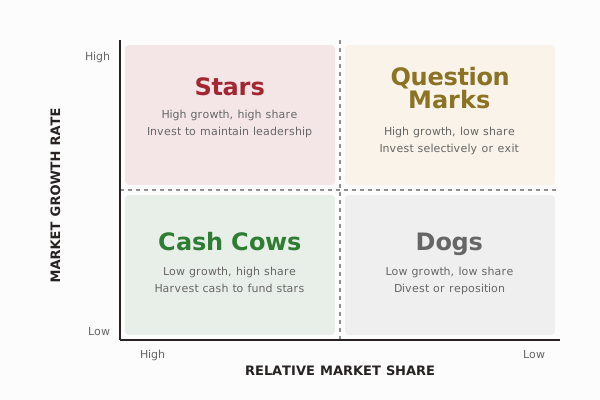
The presentation that afternoon became part of BCG lore. As Lochridge recounted to Kiechel:
Bain said, “Warren, we have a lot of things to tell you,” and laid down a single sheet of paper, “but here’s your portfolio.” Anderson thought “it was the greatest stuff ever.”
As Kiechel recounts, the team then built the same chart for each of Union Carbide’s three main competitors. Lochridge described the presentation to Kiechel:
“Instead of telling them who the different displays were, we’ll show them the different color companies and have them analyze it, and tell us what’s going on. And then at the end, the punch line was, ‘And this is you, and that’s Dow Chemical, and that’s DuPont, and that’s Monsanto.’”
The quadrant labels came last. BCG went through several iterations before settling on the names that would make the framework unforgettable:
- Stars. High share in a fast-growing market. These businesses lead their markets but need heavy reinvestment to maintain position. The goal is to fund them until the market matures.
- Cash cows. High share in a slow-growing market. The market has matured but you’re still dominant. These businesses throw off more cash than they need. Their job is to fund everything else.
- Question marks. Low share in a high-growth market. The market is attractive but you’re not winning. The hardest strategic calls: invest aggressively to become a star, or exit before you waste more cash.
- Dogs. Low share in a low-growth market. No growth potential, no cash generation, and no competitive advantage. The default recommendation was divestiture. (Kiechel notes the dog was “sometimes pictured as a long-eared, sad-eyed beagle looking about as forlorn as its corporate future.”)
BCG began presenting the matrix publicly, which did not sit well with Mead Corporation. As Zakon recalled: “Mead got totally pissed. They felt it was proprietary to them, that Wommack had contributed to the naming of some of the elements. It took them about nine months before they talked to me again. But they got over it.”
The matrix in action
The growth-share matrix was never meant to be a classification exercise. It was a tool for making specific decisions about where to invest and where to divest.
American Standard: when to sell your best growth prospect
Kiechel details the American Standard case in Lords of Strategy. The company was pouring capital into a small air-conditioning business in a market dominated by Carrier. In the language of the matrix, they were funding a question mark like a star.
When CEO Bill Marquard saw the analysis, the exchange with the BCG team went like this, as Zakon recounted:
Marquard said, “You know, that’s the best business we have in the company in terms of its future.” The consultants’ response: “And you’re right, we can’t afford it. I’m going to sell it, and what’s more, I’ll get a great price because it’s in a growth industry.”
As Kiechel tells it through Zakon’s account, the story had one more turn. Marquard sold the AC business and restructured aggressively. American Standard eventually earned recognition as one of the five best-managed companies in America, but Marquard was “dead in the water” with cash and no growth business. When Trane came up for acquisition in 1984, BCG had already done the analysis. Trane became American Standard’s largest and most profitable division.
Kiechel adds a coda: when Marquard died in October 2006, the Wall Street Journal credited him with having “helped save a household name with one of the great corporate turnarounds of the 1970s.” None of the obituaries mentioned consultants.
The lawn mower company: when you don’t know your market
Sandy Moose told Kiechel a story about a lawn mower manufacturer that illustrates the most common analytical mistake with the matrix: defining the market to flatter yourself. The client insisted that their dominant position should be generating profits. Moose’s account of the consultants’ questioning, from Lords of Strategy:
The executives complained: “Your logic can’t be right. We dominate our segment, but we’re not making any money at it.”
The consultants began asking questions. “Do you sell through Sears and other retailers with private-label brands, and how much of the market do they represent?” “Oh no, even though they’re maybe 45 percent of the market.” What about mass merchandisers like JC Penney, Montgomery Ward, Kmart? “No, we don’t sell there. They’re another 45 percent.” Chain hardware stores? “Ah yes, that’s our market, but only in certain markets, and not in California, because it has a kind of grass our mowers don’t cut.”
The segment the client actually served was about 5% of the total market. They weren’t a cash cow that mysteriously wasn’t producing cash. They were a dog that had drawn the market boundaries to avoid admitting it.
GE under Welch: the matrix as management philosophy
By the late 1970s, the matrix had gone mainstream. Philippe Haspeslagh at INSEAD surveyed major corporations in 1979 and published the results in the Harvard Business Review in 1982. He found that 45 percent of the Fortune 500 were using some form of portfolio matrix, and that the framework’s main value was forcing companies to analyze each business unit on its own terms, rather than treating the portfolio as a monolith.
The most famous practitioner was Jack Welch at General Electric. Welch’s directive was simple: every GE business had to be number one or number two in its market, or it would be fixed, sold, or closed. This was the growth-share matrix distilled into a management philosophy. As Kiechel notes, Welch hired Michael Carpenter, a nine-year BCG veteran, to lead GE’s strategic planning.
How to use the matrix
Define the market honestly
The lawn mower story illustrates the most common analytical mistake. If you define your market too narrowly, you’ll think you’re a cash cow when you’re actually a dog. If you define it too broadly, you’ll miss the segments where you have real competitive advantage.
A good test: which companies are competing for the same customer dollar? If the answer includes major players you don’t currently sell through, you’ve probably drawn the boundaries too narrowly.
Get relative market share right
Relative market share isn’t your market share. It’s your share divided by the largest competitor’s share. If you have 20% and the leader has 40%, your relative share is 0.5. If you have 40% and the next largest has 20%, your relative share is 2.0. This matters because the experience curve logic says the market leader should have the lowest costs and therefore the highest margins.
Market growth rate should be the overall market’s growth, not your revenue growth. A business growing at 15% in a market growing at 20% is losing ground, even though 15% looks healthy in isolation.
Getting precise numbers can be hard. Directional accuracy is enough. The point is forcing an honest conversation about which quadrant each business is actually in.
Make the hard calls on question marks
Stars, cash cows, and dogs have relatively straightforward strategies. The hardest decisions are almost entirely in the question mark quadrant.
The temptation is to fund all question marks a little. As Kiechel writes, “the mistake too many companies made was to put money into all their question-mark businesses, meaning that none got sufficient investment.” Pick the best. Give them the resources to actually gain share. Set explicit milestones and exit criteria. For the rest, exit early. A question mark that lingers for years without gaining share is the most expensive kind of strategic mistake.
Remember it’s an allocation tool
Plotting your businesses on the matrix and then funding them all equally defeats the entire purpose. Cash cows should generate more cash than they consume, stars should receive more investment than they generate, and dogs should be sold. If the matrix doesn’t change how you allocate capital, you haven’t used it. This is where the framework connects to how consulting frameworks work more generally: the analysis should lead directly to a decision about what to do differently.
Where the framework breaks down
The growth-share matrix attracted academic criticism almost from the start, and several of those criticisms have real substance.
The central assumption, that high market share leads to profitability through the experience curve, doesn’t hold universally. Paccar, the heavy-truck company discussed in the Porter’s Five Forces article, has been profitable for decades with a niche market position. As Kiechel notes, academics picked apart the dog prescription in particular. One proposed titling his paper “No Bad Dogs,” arguing that low-share businesses could be quite profitable under different management.
The BCG team eventually conceded the point. As Zakon told Kiechel:
“Being inexperienced businesspeople, we didn’t walk in there and tell them how to run their businesses. It didn’t dawn on us that the way to manage a dog was not to starve it, but to LBO it.”
The leveraged buyout wave of the 1980s proved the point. Firms like KKR made fortunes buying businesses the matrix said to dump.
There was also a human problem. As Kiechel recounts, managers of units classified as dogs took it personally. Moose told a story about presenting to the head of a Midwestern manufacturer:
The troubled silence that followed the slide was finally broken by the CEO’s plaintive remark: “Uhhh… I always liked dogs.”
The lesson, as Moose put it: “We learned to preview our presentations with the CEO before we gave it to everyone on site.”
How to think about it
The matrix’s real contribution was giving executives a common language for a conversation that didn’t exist before. Moose explained the problem to Kiechel:
“For any of these companies that had become conglomerates, there was no way they could keep the whole business in their head. Top management knew that the plans that were coming up from each unit seemed unrealistic, but they didn’t know how to push back. This was a framework that said, ‘Aha, you’re showing me a business plan where your earnings are going to grow and you’re going to get all this cash out, but this is where you are today. Are you really going to change that? What are you going to do differently?’”
That’s the question worth keeping. Not the four boxes or the animal names, but the discipline of looking at each piece of a portfolio and asking: what role does it play, and does our investment match that role? A division head comes in with projections showing earnings growth and a request for capital. The matrix gives the CEO a way to respond: you’re here today, with this market share and this growth rate. What exactly are you going to do to change that?
That question works whether you run a corporation with fifty divisions or a startup with three product lines. It’s what the best consulting frameworks do: they give you a question worth asking repeatedly, long after you’ve forgotten the diagram.
Recommended reading
Walter Kiechel’s The Lords of Strategy traces how the strategy consulting industry invented the ideas that now dominate business thinking. Kiechel interviewed the original BCG team, and his account of the matrix’s development is the most detailed one available. If you’re interested in where these frameworks actually came from, it’s the best book on the subject.