10+ types of consulting firms in 2026: what each one does
“Consulting” is a broad term. Gartner put the global consulting market at $397 billion in 2024. IBISWorld puts “management consultants” at $1.1 trillion for 2025, using a definition that leaves out IT consulting except for IT strategy work.
McKinsey, Bain, and BCG are the best-known consulting firms, but not the biggest. Gartner ranks Deloitte as the largest consulting provider, with $41.6 billion of consulting revenue by its count. BCG, the only one of the three that still publishes its numbers, made $14.4 billion in 2025 from everything it does. I track the big firms’ revenue and headcount in the strategy consulting industry report.
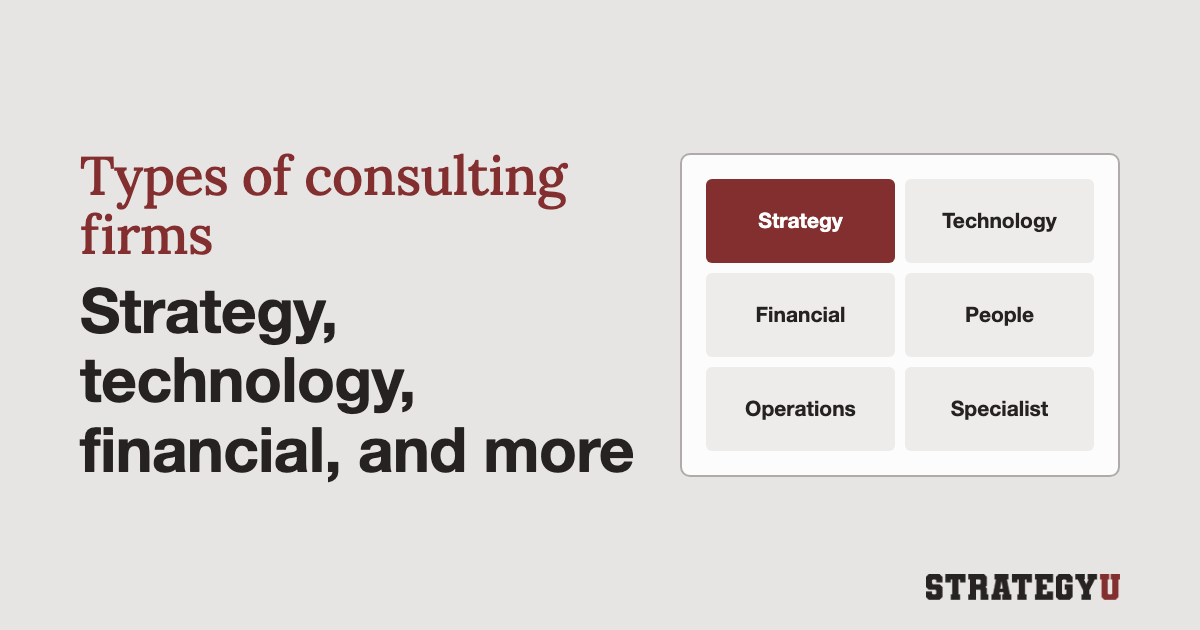
| Type of firm | Known for | Examples |
|---|---|---|
| Strategy firms | Advice to CEOs and boards | McKinsey, BCG, Bain, Oliver Wyman |
| The Big Four | Audit firms with large consulting arms | Deloitte, PwC, EY, KPMG |
| Technology firms | Building and running systems | Accenture, IBM Consulting, Capgemini |
| Deal and restructuring firms | Due diligence and turnarounds | Alvarez & Marsal, AlixPartners, FTI Consulting |
| Executive search firms | CEO and board searches | Korn Ferry, Russell Reynolds, Spencer Stuart |
| HR and benefits firms | Pay, benefits, and retirement plans | Mercer, WTW, Aon |
| Economic consulting firms | Analysis for lawsuits and regulators | Analysis Group, Cornerstone Research, CRA |
| Risk and investigations firms | Internal audit, forensics, and investigations | Protiviti, Kroll, Control Risks |
| Industry and functional specialists | One industry or one function | Huron, ZS, Simon-Kucher, ERM |
| Design and innovation firms | New products and services | IDEO, Innosight |
| AI firms | Building AI systems | QuantumBlack, BCG X, Tenex, Distyl |
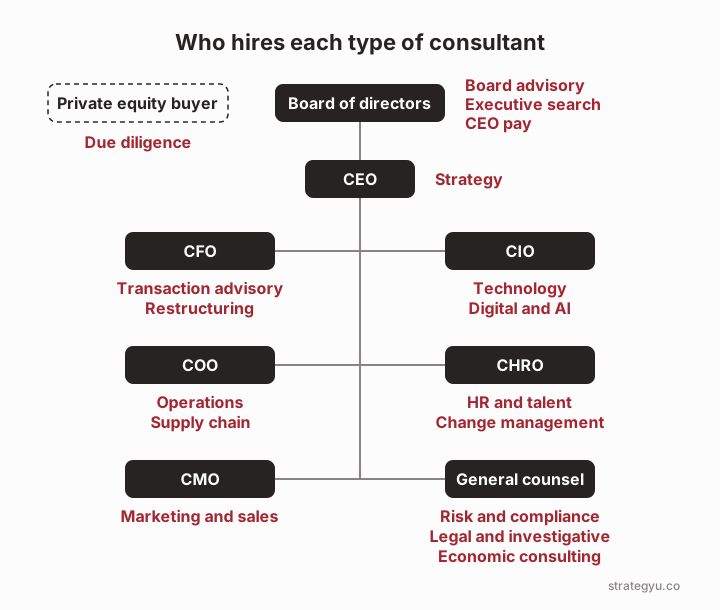
The chart shows who inside a company usually hires each kind of consulting.
1. Strategy firms
Examples
- McKinsey & Company
- Boston Consulting Group
- Bain & Company
- Oliver Wyman
- Roland Berger
- L.E.K. Consulting
- Kearney
- OC&C Strategy Consultants
McKinsey, BCG, and Bain sit at the top, with a second tier that includes Oliver Wyman, Roland Berger, L.E.K., and Kearney. They work with CEOs, executive teams, and boards on questions like entering new markets, restructuring a business, or responding to a competitor, and they use structured frameworks to break those problems down. The industry has kept growing despite predictions of disruption, and its history goes back to McKinsey’s founding in 1926.
Ethan Rasiel, who worked in McKinsey’s New York office from 1989 to 1992, describes the basic unit of the business in The McKinsey Way:
McKinsey bills by the hour, and those hours do not come cheap. … The challenge for the ED [engagement director] is to balance the desires and budget constraints of the client with the limits of the team. The ideal synthesis of these two opposing forces is a project that a team of four to six consultants can complete in three to six months and that will produce tangible results for the client.1
He’s also plain about what clients pay for: “Brainstorming is the sine qua non of strategic consulting. It’s what the clients really buy.”2
Not every project at these firms is that short. At BCG I helped build the commercialization strategy for the transformation practice, which meant writing reports and working out how to position and sell that work to clients. Most of those projects ran 6 to 18 months, and we worked with many of the same clients for years.
Bain set itself up differently from the start. In Walter Kiechel’s account in The Lords of Strategy, the firm “would work for only one company in an industry, or, more precisely, in a competitive set, and only if that company agreed to a continuing, probably multiyear relationship.” The firm’s pitch, as Kiechel records it, was “We don’t sell advice by the hour; we sell profits at a discount.”3
Some of the second tier came out of the first. When McKinsey’s original firm split after James McKinsey died in 1937, Kiechel writes, “One-half was to become A.T. Kearney, a consulting firm specializing in operations management for manufacturers.”4 Oliver Wyman is now owned by Marsh, which reports the firm’s results as “Marsh Management Consulting”: $3.6 billion in 2025.
When TC Energy announced in July 2023 that it would spin off its liquids pipelines business, its filing listed six advisors: two banks advising the company, Evercore advising the board, two law firms, and then this line: “TC Energy has also engaged Bain & Company to advise on the separation process.”
2. The Big Four
Examples
- Deloitte (Monitor Deloitte)
- PwC (Strategy&)
- EY (EY-Parthenon)
- KPMG
Deloitte, PwC, EY, and KPMG are accounting firms, and each runs a consulting business next to its audit and tax work. That consulting covers strategy, technology, deals, risk, and people work.
KPMG’s consulting arm became its own company in 2000, listed on Nasdaq in 2001, and took the name BearingPoint in 2002. Its 2003 annual report describes the market it was competing in: “some of the former ‘Big 5’ accounting and consulting firms have sold their consulting businesses and another completed its initial public offering.” When IBM agreed in July 2002 to buy PwC’s consulting unit for about $3.5 billion, PwC’s chief executive, Samuel DiPiazza, said in the joint announcement that the sale “will unleash the consulting unit from the regulatory restraints of our industry.”
In 2013 and 2014, three of them bought strategy firms. Deloitte bought Monitor in January 2013, in a sale approved by the US bankruptcy court in Delaware, and renamed it Monitor Deloitte. PwC completed its purchase of Booz & Company in April 2014 and renamed it Strategy&. EY bought the Parthenon Group the same year, kept the Parthenon name, and ran it as part of its transaction advisory business.
EY-Parthenon, EY’s strategy and transactions arm, made $6.8 billion in the year to June 2026, and EY’s consulting service line made $17.4 billion, more than twice as much. KPMG said its advisory growth in fiscal 2025 came from “continued demand for our managed services” and from projects done with alliance partners, the work of running systems for clients rather than advising them.
Deloitte’s fiscal 2026 results describe Zora AI, a platform “that deploys a digital workforce within client environments,” along with AI infrastructure and robotics services. EY and Microsoft are putting $1 billion into a joint program to build AI tools for clients.
Audit rules still limit what each firm can sell to the companies it audits. When the Arizona Supreme Court approved KPMG’s law firm, KPMG Law US, in February 2025, it set the condition that the firm “will not perform legal services for clients for which KPMG LLP or other KPMG member firms conduct financial statement audits or attestations.” Deloitte’s Monitor announcement includes the line “Certain services may not be available to attest clients under the rules and regulations of public accounting.”
EY’s Project Everest would have turned its auditors and its consultants into two separate firms. EY gave up on it in April 2023 when the US firm wouldn’t go along. “We have been informed that the US Executive Committee has decided not to move forward with the design of Project Everest,” EY’s global executive committee told partners, in a note an EY spokesperson gave to City AM. The committee said it remained committed to “creating two world-class organisations that further advance audit quality, independence and client choice.”
3. Technology firms
Examples
- Accenture
- IBM Consulting
- Capgemini
- Infosys
- Cognizant
- Deloitte’s technology practice
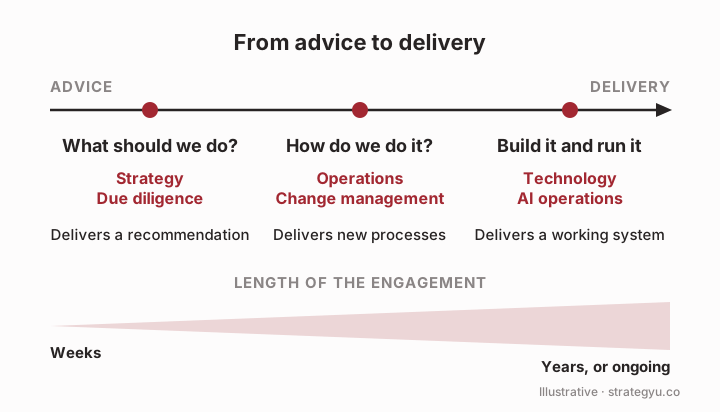
Technology consulting firms design, build, and run the systems a client depends on: ERP rollouts, cloud migrations, websites and apps, data platforms, and now AI systems. If strategy consulting answers “what should we do?”, this kind of firm answers “how do we actually do it?”
Accenture made $74.18 billion in its fiscal year to August 2026, with about 814,000 people, and its consulting revenue alone, $36.88 billion, is more than twice BCG’s total revenue for 2025. The running is now bigger than the advice: Accenture’s managed services revenue grew 6% in local currency to $37.30 billion, while consulting grew 3%. A year earlier consulting had been the larger of the two.
IBM’s consulting business brought in $21.1 billion in 2025 at an 11.7% segment margin, about a third of the 33.1% margin on IBM’s software.
The projects are big and they often run over. A 2012 McKinsey and University of Oxford study of more than 5,400 IT projects found that “half of all large IT projects … massively blow their budgets. On average, large IT projects run 45 percent over budget and 7 percent over time, while delivering 56 percent less value than predicted.” Large meant an initial price tag over $15 million.
Hertz sued Accenture in 2019 over a rebuild of its website and apps. The complaint says Hertz chose Accenture “After Accenture put on an impressive, one-day presentation for the Hertz team that included a demonstration of the transformed Hertz digital experience,” and goes on:
During that time, Hertz paid Accenture more than $32 million in fees and expenses. Accenture never delivered a functional website or mobile app.
The companies agreed to dismiss Hertz’s claims in August 2021, with each side paying its own legal costs.
4. Deal and restructuring firms
Examples
- Alvarez & Marsal
- AlixPartners
- FTI Consulting
- Strategy firms’ private equity practices
- Big Four deal practices
These firms show up around a transaction or a crisis: diligence before a company is bought, and restructuring when a company is in trouble.
Private equity buyers are big customers for diligence. Buyout firms invested $904 billion in 2025, up 44% from 2024, according to Bain’s 2026 private equity report. The strategy firms compete for that work too. Bain says it has done more than 22,000 due diligence cases and works with “about 80% of the largest private equity firms in the world.”
Kiechel quotes Dan Haas, one of the founders of Bain’s private equity practice, on why the firm likes the work: “Quite frankly, it’s the purest type of Bain work there is … because it’s all about creating value, you’ve got a motivated management team, and the stakes are incredibly high for everyone.” By Haas’s estimate to Kiechel, buyout firms and the companies they owned were about a quarter of Bain’s revenue in 2007, the top of the buyout boom. Before a purchase, Kiechel writes, Bain performs “what it calls ‘strategic due diligence,’ surveying the industry and players across the potential property’s value chain, from its suppliers to its customers.”5
The strategy firms and the deal specialists are close enough to hire from each other. In May 2026, Alvarez & Marsal named two Bain partners, Jen Holland and Liz Pearsons, to co-lead its US commercial due diligence practice.
Restructuring is old work for consultants. In a 1953 speech quoted in Elizabeth Haas Edersheim’s McKinsey’s Marvin Bower, Bower said that “nearly all of our engagements during the middle thirties were general surveys for banks, bondholders’ committees, and directors to determine what could be done to put the company on a profitable basis.”6
Today’s restructuring specialists don’t stop at advice. When Lehman Brothers went bankrupt in September 2008, it hired A&M and made Bryan Marsal its chief restructuring officer at $850 an hour, with other A&M staff billing between $175 and $850 an hour. The engagement letter spells out the job:
The CRO, together with any Additional Personnel, in cooperation with the Chief Executive Officer of the Company (the “CEO”), shall perform a financial review of the Company, including but not limited to a review and assessment of financial information that has been, and that will be, provided by the Company to its creditors, including without limitation its short and long-term projected cash flows; … The CRO shall serve as the principal contact with the Company’s creditors with respect to the Company’s financial and operational matters
The next summer, after GM’s main business was sold through the bankruptcy court, the company left behind, renamed Motors Liquidation Company, elected AlixPartners’ Albert Koch as its CEO, billed at $835 an hour. A&M was also Spirit Airlines’ restructuring advisor when it filed for bankruptcy in November 2024. FTI Consulting is public, so its numbers show the scale of the business: $3.789 billion of revenue in 2025, with its corporate finance segment the largest at $1.55 billion.
5. Executive search firms
Examples
- Korn Ferry
- Heidrick & Struggles
- Spencer Stuart
- Russell Reynolds Associates
- Egon Zehnder
Search firms are paid a share of the hire’s pay. In Korn Ferry’s annual report, “Fee revenue from executive and professional search activities is generally one-third of the estimated first-year cash compensation of the placed candidate.” Heidrick & Struggles reported that its average revenue per executive search was $146,000 in 2024.
About 80% of Korn Ferry’s executive searches in fiscal 2026 were “for board level, chief executive and other senior executive and general management positions,” and over fiscal 2025 and 2026 it worked with 82% of the S&P 500. When CarMax announced its CEO transition in November 2025, its filing said the search for a permanent CEO “is being supported by leading professional search firm Russell Reynolds Associates and is being overseen by the Compensation and Personnel Committee.”
I worked at Russell Reynolds, where executive search, especially at the CEO and board level, is the core of the business. But most of these firms also do leadership advisory work: succession planning for senior executives, and talent assessment, which can include psychological testing of senior executives to see whether they’ll fit. That kind of leadership and talent consulting sits inside many of the search firms, and there are also separate firms that only do it. Korn Ferry now describes itself as “a global consulting firm,” and it reported $2.9 billion of fee revenue for fiscal 2026.
The search firms also advise boards. Board advisory was the part of Russell Reynolds I worked in: board governance audits and board effectiveness consulting, working mostly with the board itself. I’d put that closer to strategy work, because the board is the client. CEO succession sits closer to talent work, since it’s mostly planning and assessing the people a company already has. Spencer Stuart’s 2026 board index found: “One-third of boards now report working with an external partner to facilitate evaluations, up from only 3% a decade ago.”
6. HR and benefits firms
Examples
- Mercer
- WTW
- Aon
- Prosci
- Deloitte and PwC people practices
HR consulting firms like Mercer, which made $6.2 billion in 2025, WTW, and Aon design pay, benefits, and retirement plans. The most visible part of the work is advising the board on executive pay, and US proxy statements describe it. Here is T-Mobile’s 2026 proxy:
The Compensation Committee has retained Mercer … as its independent compensation consultant. Mercer assists the Compensation Committee in its evaluation of the compensation and benefits provided to the Chief Executive Officer and the other executive officers. Mercer generally attends Compensation Committee meetings at which executive officer compensation is discussed and provides information, research and analysis pertaining to executive compensation as requested by the Compensation Committee. … During 2025, the aggregate fees for such services were approximately $370,000.
The same proxy says Mercer earned about $344,000 more that year for investment, benefits, and retirement plan consulting that management approved. The firm advising the board on what to pay the executives was also doing paid work the executives signed off on. The committee “determined that Mercer is (and was, during 2025) independent.”
Change management firms work on the people side of a big transition, like a merger, a reorganization, or a new system. Prosci, which owns the ADKAR change model, runs a three-day certification program for the people who lead that work inside companies.
7. Economic consulting firms
Examples
- Cornerstone Research
- Analysis Group
- Charles River Associates
- Compass Lexecon (FTI Consulting)
- NERA Economic Consulting
Economic consultants build the analysis behind expert testimony in lawsuits and regulatory cases. Analysis Group’s careers page lists what its case teams do, including “Do research for an academic or industry expert who will testify in court as an expert witness” and “Help attorneys understand the expert witness opinions.”
Charles River Associates, which made $751.6 million in its 2025 fiscal year, uses outside professors for expert testimony and lists in its annual report the universities it draws them from, including Yale and the University of Chicago. It adds: “These experts also generate business for us.” About 79% of CRA’s senior staff have advanced degrees, and 51% of those degrees are doctorates.
In the Epic v. Apple contempt case, Apple pointed to an Analysis Group report to support the commission it charged on purchases made through links out of its apps. The trial court called Apple’s reliance on the report “a sham,” and in December 2025 the Ninth Circuit let that finding stand, noting that “the record suggests that Apple picked its commission rate in July 2023, and the report is dated January 2024.”
8. Risk and investigations firms
Examples
- Protiviti
- Kroll
- Control Risks
- Ankura
- FTI Consulting
- Big Four risk and forensic practices
These firms cover internal audit, regulatory compliance, forensic accounting, and investigations for companies facing lawsuits, fraud allegations, or regulators. Protiviti, now part of Robert Half, was built in 2002 from more than 700 people who had worked in Arthur Andersen’s internal audit and risk consulting practice, according to Robert Half’s annual report. It made $1.95 billion in 2025. FTI Consulting’s forensic and litigation consulting segment brought in $764.7 million that year.
9. Industry and functional specialists
The rest of the market is a long tail of firms that serve one industry or one function.
Healthcare and life sciences
Examples
- Huron
- IQVIA
- ZS
- ClearView Healthcare Partners
- The Chartis Group
These firms work on hospital operations, regulatory compliance, clinical development, and market access for drugs. Huron, which made a record $1.66 billion in 2025, gets half of its revenue from its healthcare segment.
Pricing, marketing, and sales
Examples
- ZS
- Simon-Kucher
These firms help companies grow revenue through pricing, sales force design, and marketing strategy. ZS, founded in 1983, has more than 15,000 employees.
Operations and supply chain
Examples
- GEP
- Chainalytics
- Kearney
- Strategy firms’ operations practices
These firms help companies cut costs, run plants and warehouses better, and manage suppliers.
Sustainability
Examples
- ERM (Environmental Resources Management)
- BSR (Business for Social Responsibility)
- Deloitte Sustainability Services
These firms help organizations measure and reduce their environmental impact and meet regulatory and ESG reporting standards.
10. Design and innovation firms
Examples
- IDEO
- Innosight (Huron)
- Doblin (Deloitte)
These firms help companies develop new products and services, from early ideas through prototypes to launch plans. Some have been folded into larger firms: Innosight is now part of Huron, which runs it as its strategy and operations business.
11. AI firms
Examples
- McKinsey (QuantumBlack)
- BCG (BCG X)
- Tenex
- Distyl AI
This is the newest kind of firm, and it comes in two forms: AI units inside the big firms, and new companies that build AI systems for clients.
The big firms are selling a lot more AI work. BCG says AI- and tech-focused services are now “over 40% of BCG’s total revenue,” and it calls BCG X “the tech build and design unit of BCG,” with more than 3,000 tech builders, designers, and entrepreneurs. EY says its sales from AI services grew 49% in fiscal 2026. McKinsey’s CEO, Bob Sternfels, told HBR IdeaCast in January 2026 that the firm is “migrating pretty quickly away from, let’s call it pure advisory work” toward a model where “we will underwrite the outcomes of that business case,” and that “about a third of our revenues total are underwriting outcomes.” He counted McKinsey’s workforce as “40,000 humans and 20,000 agents.”
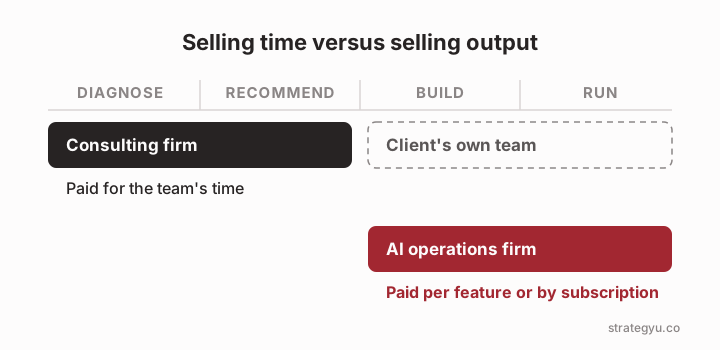
The new firms sell output instead of hours. Tenex sells AI-assisted engineering squads that build software for clients: “We charge our clients based on what we produce, measured by story-points that we define.” Tenex pays its own engineers on the same story points. Distyl describes “forward-deploying our teams of engineers and researchers who own the outcome.”
Traditional consulting sells time, and these firms sell output, which is a different economic model from the one the industry was built on.
Whether this actually disrupts the big firms or gets absorbed the way analytics, digital, and design all got absorbed is an open question. The big firms have pulled in every prior wave. But moving from selling time to selling outcomes requires changing how you hire, staff, price, and make money. That’s harder than bolting on a new practice area.
If you’re interested in breaking into consulting yourself, check out our guide on how to become a strategy consultant. And if you want to sharpen the analytical thinking that consultants use every day, our case interview frameworks guide is a good place to start.
Footnotes
Ethan M. Rasiel, The McKinsey Way (1999), pp. 53-54. ↩
Rasiel, The McKinsey Way, p. 93. ↩
Walter Kiechel, The Lords of Strategy (2010), chapter 5, “What Bill Bain Wanted.” ↩
Kiechel, The Lords of Strategy, chapter 6, “Waking Up McKinsey.” ↩
Kiechel, The Lords of Strategy, chapter 15, “Three Versions of Strategy as People.” ↩
Elizabeth Haas Edersheim, McKinsey’s Marvin Bower (2004), pp. 28-29. ↩
The course
Think Like a Strategy Consultant
Structured problem solving, MECE, the Pyramid Principle, and slides that make a point, in one self-paced video course. 1,500+ students in 65+ countries.
Or 2 payments of $398.
Watch a free lesson from Think Like A Strategy Consultant →Free
Start with the email course
Six short lessons on consulting fundamentals, one a day.