
The strategy consulting industry in 2026
Revenue at the big consulting firms kept growing through 2025. Headcount did not.
BCG closed the year at $14.4 billion, up 7% from $13.5 billion and its 22nd consecutive year of growth, according to the firm’s April 2026 announcement. Over roughly the same stretch McKinsey went from about 45,100 people at the end of 2023 to about 40,000 by May 2025. Fortune reported that decline of more than 10% as the largest in the firm’s history, and McKinsey attributed it to normal attrition and performance reviews rather than layoffs.
Who actually publishes their numbers
Revenue figures for these firms get quoted in case interviews and board decks by people who have no idea whether they came from the firm or from an aggregator taking a guess.
Only one of the three tells you much. BCG’s April 2026 release and its own about page put 2025 on the record: $14.4 billion in revenue, 7% growth, 33,500 employees, and offices in more than 100 cities across more than 50 countries. AI and tech services make up over 40% of that revenue, and BCG says its AI services grew 25% year over year.
McKinsey used to publish this and stopped. Page four of its 2023 ESG report executive summary listed 45,100 colleagues, 68 countries, 4,100 clients served, and $16B revenue. Reporting the FT published in May 2025 notes that the following year’s report “did not include staff numbers” and “did not include a figure for 2024 revenue, unlike in previous years.” So the $16 billion everyone quotes is McKinsey’s own number for 2023, and nothing has replaced it since. Anyone citing it as a current figure is citing a three-year-old disclosure. Headcount is better tracked because reporters have followed it: roughly 34,000 in 2020, 45,100 at the end of 2023, and about 40,000 in 2025.
Bain tells you the least of anyone. Its about page offers “Across 67 cities in 40 countries” and a founding year of 1973, and that’s about it. The closest thing to a disclosure comes in its press releases: when Christophe De Vusser took over as worldwide managing partner in July 2024, Bain’s own announcement quoted him on “our extraordinary team of 19,000 Bainies around the world,” and added that “Tech and AI enabled revenue is already driving 30% of the firm’s business in 2024.” For revenue you are left with outside estimates: Forbes carries $7.5 billion and 19,000 employees as of August 2026, credited to FactSet and Forbes.
Be careful with Bain numbers generally. Wikipedia’s infobox lists “$14 billion (2025)” and cites that same Forbes profile, which says $7.5 billion. The citation does not support the figure, and it has been copied into other comparison articles by people who never opened the source.
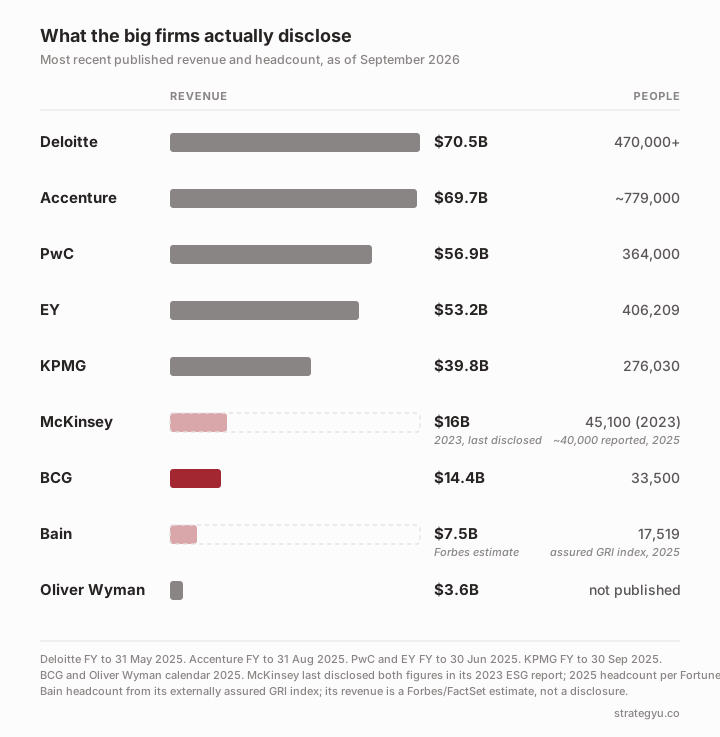
Headcount numbers get lined up as though they measure the same thing, and they don’t. BCG’s 33,500 counts total employees, which sweeps in AI engineers, data scientists, IT architects, and support staff. Count only client-facing consultants and you’d get something much smaller. Any ranking that separates two firms by a thousand people is usually comparing two different definitions.
It also helps to see MBB against the firms that do file real numbers. Deloitte reported $70.5 billion in global revenue for the year ended 31 May 2025, up 4.8% in local currency, with more than 470,000 people. Accenture reported $69.67 billion for the year ended 31 August 2025, up 7%, with approximately 779,000 people, of which $35.11 billion was consulting.
BCG is about a fifth the size of either one. The strategy firms sit at the top of the pricing pyramid and nowhere near the top of the revenue one, whatever people mean when they call MBB “the biggest firms in consulting.”
If you want the wider map of who does what, I broke down every type of consulting firm and market segment separately.
The correction of 2024 and 2025
Firms over-hired during the post-2020 boom, and the correction has been running for about three years.
McKinsey’s version was quiet. Five thousand fewer people over eighteen months, no announced layoff, and a lot of performance management that never had to be called anything else.
Accenture said the quiet part out loud. In the fiscal 2025 fourth quarter the company started a six-month “business optimization program” and took a $615 million charge, with another $250 million expected in the following quarter. The stated talent strategy was to invest in upskilling, and then:
exiting people in a compressed timeline where reskilling is not a viable path for the skills it needs
That’s a public company explaining, in a press release, that people who can’t be retrained for what it now sells are on their way out.
The Big Four took it out of the entry level instead. Consultancy.uk reported in September 2025 that PwC cut its UK graduate intake from 1,500 to 1,300. Marco Amitrano, PwC’s UK chief, tied the decision to the market rather than to AI:
At PwC, our entry-level numbers are lower this year, reflecting the wider slowdown in investment, hiring and deal-making.
Asked about technology in the same piece, he was more careful: “Innovation in AI is certainly reshaping roles. For now, the development of new tools and the parallel investment in skills are offsetting more serious disruption.” None of the MBB firms has said anything that direct, and “for now” is the qualifier to watch.
Where the growth is coming from
The growth the firms describe is AI work, and they say so.
BCG’s 40% of revenue from AI and tech, growing 25% a year, is the headline number. Accenture’s fiscal 2025 results report $5.9 billion in generative AI new bookings for the year, out of $80.6 billion in total new bookings.
What gets less attention is what’s happening to everything else. In Accenture’s third quarter of fiscal 2026, consulting revenue was $9.33 billion, up 4% in dollars but only 1% in local currency, while managed services grew 5% in local currency over the same quarter. For the full fiscal year the company now expects revenue growth of 3% to 4% in local currency. Advisory work is close to flat while the running-your-systems work keeps growing.
That mix is why headcount can fall while revenue rises.
The pyramid is getting thinner at the bottom
The economics of a strategy firm depend on the ratio of juniors to seniors. A partner sells the work, a manager runs it, and a large group of analysts and associates does the analysis at a billing rate well above what they cost.
McKinsey CEO Bob Sternfels described the direction on Harvard Business Review’s IdeaCast in January 2026:
I often get asked, “How big is McKinsey? How many people do you employ?” I now update this almost every month, but my latest answer to you would be 60,000, but it’s 40,000 humans and 20,000 agents.
He went on to say that “Little over a year and a half ago, that was 3,000 agents and I originally thought it was going to take us to 2030 to get to one agent per human. I think we’re going to be there in 18 months and we’ll have every employee enabled by at least one or more agents.”
The pay data points the same direction. Poets&Quants reported in January 2026, citing Management Consulted’s salary report, that “For a third consecutive year, starting consulting salaries at both the undergraduate and MBA entry levels have remained largely unchanged.” MBA base salaries sit at $192,000 at McKinsey and Bain and $190,000 at BCG. Undergraduate hires start around $112,000 in base with total packages in the $137,000 to $140,000 range. Entry pay has now been flat for three consecutive years, which is not what a business does when it is competing hard for the next analyst class.
The sharpest objection to all of this came from inside McKinsey. Debasish Patnaik, the senior partner who leads QuantumBlack, the firm’s AI arm, pointed out that banks are cutting junior analyst classes by as much as two-thirds while sourcing roughly 62% of their AI talent from those same cohorts. Fortune carried his comment in June 2026:
Banking is an apprenticeship business. Today’s junior analysts become tomorrow’s managing directors. Senior judgment cannot be manufactured laterally.
He was describing banks, but consulting runs on exactly the same apprenticeship, and nobody has explained where the 2035 partners come from if the 2026 analyst class is half the size.
[PAUL: your take here. You did the analyst job at McKinsey and the knowledge-expert job at BCG. Which parts of that work do you think a model genuinely absorbs, and which parts were only ever learnable by doing them badly in front of a manager for two years?]
I’ve written separately about what AI does well in knowledge work and why McKinsey’s knowledge investment put it in a decent position for this.
What the jobs pay
Entry-level pay has stopped moving, and senior pay hasn’t.
MBA hires at the Big Three start at $190,000 to $192,000 in base and undergraduate hires at around $112,000, and neither number has meaningfully changed since 2023.
Above that level things get much larger. I covered the full picture in a separate breakdown of strategy consulting compensation built on the Charles Aris study of 795 current consultants, including what people earn at each level, what exit offers look like, and how much of partner pay is base salary versus profit sharing. If you’re trying to understand titles and promotion timing rather than pay, the analyst-to-partner role guide maps how the firms name each level.
Whether it’s still worth joining a firm
Nothing has broken on pay. Firms are still handing six figures to twenty-two-year-olds and seven figures to partners, and Clayton Christensen’s prediction that the industry would be disrupted from below has not aged well.
Structurally, though, three things have changed since I’d have given this advice five years ago. Entry-level classes are smaller, so getting in is harder. The work a first-year does is changing, and nobody can tell you what it will be in three years. And the firms are recruiting a different profile: that same Fortune report on McKinsey says candidates are now tested on working with Lilli, the firm’s internal AI tool, and that the firm is looking harder at liberal arts backgrounds for judgment and creativity rather than only at the finance and engineering pipeline.
If you’re deciding, the honest framing is that consulting is still one of the best two-to-four-year training programs available for structured problem solving, client work, and communication, and that it’s a worse bet than it used to be as a decade-long career plan. Those are two separate questions, and most people collapse them into one. I’ve written about how to build the skills with or without joining a firm, and about what the job actually looks like day to day before anyone romanticizes it.
[PAUL: your current advice to someone choosing between an MBB offer and a good corporate strategy or startup role in 2026. Has the answer changed from what you’d have said in 2019?]
[PAUL: anything on how the McKinsey vs BCG difference you wrote about in /mckinsey-boston-consulting-group-comparison/ shows up in how the two firms are handling the AI shift? BCG is publishing its AI revenue share, McKinsey is publishing its agent count. That difference feels like the same cultures you described.]
The 2027 recruiting season is the thing worth tracking. If the firms hold entry-level salaries flat for a fourth year and cut class sizes again, they’ll have decided the apprenticeship is optional, whatever they say publicly about AI making their people more capable. Check the analyst class sizes in the fall.