The Ultimate Guide To Becoming A Freelance Consultant: 28 Things I've Learned
In 2012, I was first exposed to the world of freelance strategy consultants while working for a-connect. I encountered a number of people who had opted out of traditional paths and for many different reasons (autonomy, flexibility, excitement) decided to work on their own.
At the time, I had a hunch that this was a path I wanted to explore. I’ve always been someone with shifting interests and love pushing myself into new domains. By the nature of our current job market, we cling to traditional beliefs around job loyalty, time in role, and grey-haired experience. I wanted to optimize for skills, learning, and challenge. To many, doing the same thing over and over was “putting in your time,” but to me was the goal to avoid.
After having a couple more jobs which I continued to learn, develop confidence in my skills and gain more clarity over the type of work I wanted to do, I decided it was time to make the leap. I wrote the first version of this list about a year after I quit in 2017. I’ve now been self-employed for more than nine years, so I’ve added notes where my view has changed and a section at the end on what I’d add now. Here’s the playbook:
Phase 1: Decide before you quit

1. Test your commitment
In my career, I’ve often tested out next steps in my career by telling people what that next step might be and then judging both my reaction and theirs. For example, early in my career, I would tell people “I am trying to break into consulting.” As I said it, it felt like something I really wanted to do and others acted with support. Test out “I’m making the leap to become a freelance consultant.” If it doesn’t feel right, you may want to re-think your move. You also want to challenge yourself to become comfortable with uncertainty.
The question of “what if I can’t find a project” is inevitable and you will likely face this over and over as a consultant. If that lingering fear is going to overwhelm your ability to take action, this may not be the path for you.
2. Start building momentum
For me, this meant reaching out to a number of friends and other connections who were currently freelance consultants. I had a number of great conversations and I asked them accounting, business and life questions. Some of the best advice I got is included here. You also want to start thinking about your network and identifying the supporters you have through family, colleagues and past jobs. People tend to dramatically underestimate the number of people that are rooting for them, so it’s good to start a list.
3. Learn about the freelance talent marketplace
I wrote a more detailed piece on the talent marketplaces, but you should start checking out and signing up for accounts on the different platforms. You can join platforms like Catalant, PwC, and UpWork before you become a full-time freelancer. Others like a-connect, Umbrex, and BTG require you to be on your own before joining. You may also want to see if you can win a small project on one of those platforms before you take the leap just to build additional momentum.
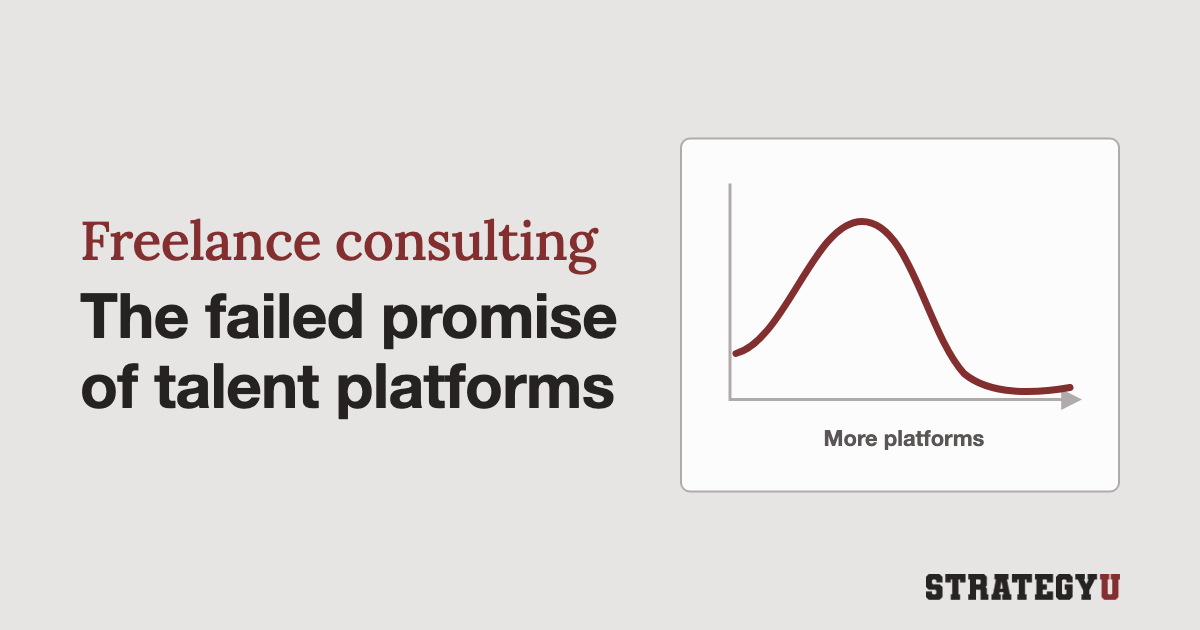
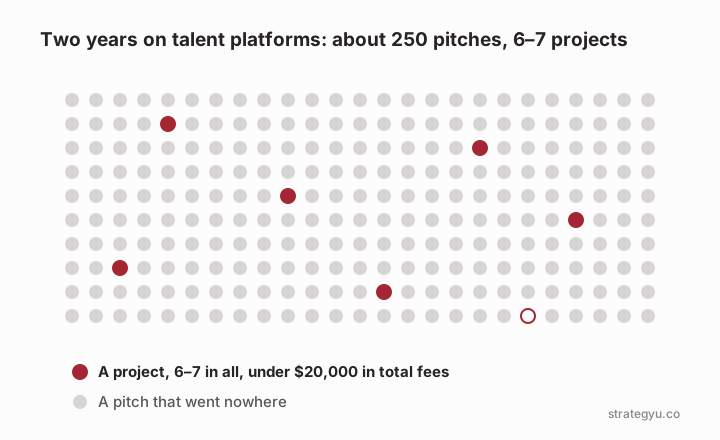
Two years in, I added up how this had gone. As I wrote in The failed promise of freelance consulting talent platforms:
Over the past couple of years, I’ve “pitched” about 250 projects for 10+ different talent platforms and have actually worked on 6–7 projects totaling less than $20,000 in gross fees.
When I looked back at my freelance work in 2021, 95% of my clients had come through my personal network or from people who knew me through social media.
4. Know which stage you’re in
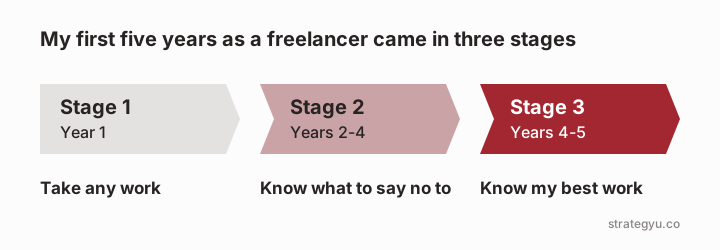
When I looked back on my first five years in 2021, I saw three stages:
- Stage 1: Desperate to succeed, will take any work within reason (Year 1)
- Stage 2: Know what I will say no to, but not sure what I want to do long-term (Years 2-4)
- Stage 3: Understanding a couple of areas where I can do great work and am starting to have a coherent perspective and offerings (Years 4-5)
I wrote the original version of this list during stage one.
5. Tame your fears
One of the biggest challenges in becoming a freelancer is the lack of structure relative to being employed full-time. When you are employed full-time, much more of your schedule is fixed and there is almost absolute certainty around income and costs. One exercise I have all people go through who are thinking about taking the leap is the fear setting exercise, which forces you to write down some of your worst fears in relation to finances and other fears of failure.
6. What if you run out of money?
Part of the fear setting exercise is to write down an income you would be comfortable with. For many people, this is the first time they think about income as something you need to continually earn instead of something that is fixed and comes in at a regular pace.
You can use my free target income calculator to determine what kind of income you need to make to support your lifestyle. When I went through this exercise, I became more aware of the link between my spending and the amount of income I needed to make in a way that enabled me to cut spending on things I didn’t value.
In The Pathless Path, I admitted how late I came to this:
This seems crazy now, but it didn’t occur to me to radically cut my spending until after I left my job. A trained consultant and former financial analyst who had spent hundreds of hours building models for companies, I had never bothered to create a detailed model of my own spending. What was I thinking?
7. Set a timeline
For me, I set out as a freelancer to make this a minimum one-year commitment. I made a number of changes in my finances, including lowering my rent and changing some of my spending habits. Mentally I committed to a full year no matter if I actually landed any work or not. I looked at the year as a real-world grad school. If I didn’t have things to work on, I would focus on building new skills and pushing myself personally. My initial due diligence convinced me I would land some work, but in my head, my “worst case scenario” was a year off of work to learn, reflect and grow.
Years later, I wrote about the number that made this feel reasonable:
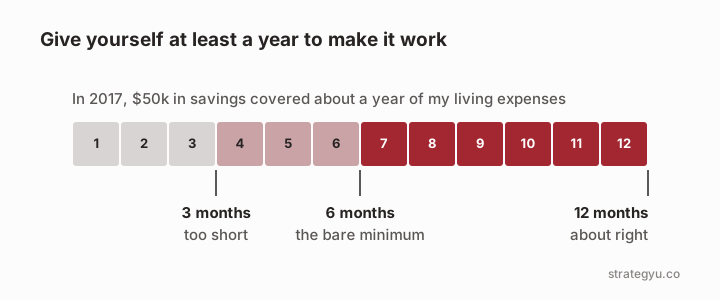
When I hit $50k in savings, something shifted. Part of it was the reality of growing my savings each month. But the deeper shift was that I was starting to do the math. With some small reductions in spending, $50k in savings represented a year of living expenses.
In Good Work, I wrote about what came next: “I felt free with $50,000 in savings before quitting, but as soon as I saw that amount start to shrink, I felt the world closing in around me.”
In my experience three months is too short, six months is the bare minimum and at least 12 months is about right in order to align your behavior and commitment with making it work.
8. Do it!
It’s hard to set up an independent gig before you leave your full-time job so there is definitely uncertainty in taking the leap. If possible, you can consider trying to turn your current employer into your first client, but if not possible, you have to expect to not have a clear path forward. I didn’t manage it either. As I wrote in 2022, “Many people secure some client work before they leave their job. I failed to do so despite some attempts. I was a freelancer in name only.” I celebrated my leap by spending four weeks in Europe. The trip had two benefits — it helped me re-energize after a previously stressful job and also start to reflect deeper on what some of my goals are in my freelance work and start identifying the type of people I wanted to work with.
Phase 2: Set up the business

1. Get a business credit card
My accountant’s advice was to either use an existing personal card solely for business expenses or to apply for a new one. I decided to use a no-fee chase credit card I already had and only use it for business expenses. This is linked directly to my Spark Business Bank (see step 3), but is good to set up before paying fees to incorporate your company so that you can expense it easily.
Later, I used the Chase Ink Business Preferred card (not an affiliate link).
2. Incorporate your company
I used LinkedIn ProFinder, now LinkedIn Services, to connect with local lawyers and accountants to get initial advice on business structure and finances (UpWork is great for this too). The consensus was that an LLC is an ideal setup for working as a freelance consultant. You can also set-up as a corporation, which is better if you plan to grow or offer other services but is more time-consuming annually as you have to file shareholder minutes. You can use services like legalzoom.com to incorporate, but beware as some states have extra requirements (such as in New York, there is a publishing requirement that LegalZoom will not cover). You typically need to file an Articles of Incorporation and an Operating Agreement.
3. Get your EIN & apply for a business banking account
You can quickly get an EIN for your business through this government site. Once you have this, you can set up a corporate bank account. I looked extensively and Capital One’s Spark Digital Business Banking was clearly the best option for avoiding most fees. It offers free banking as long as you are comfortable banking digitally. I could not find another comparable option and be happy to use them as I have been a satisfied Capital One 360 customer for years.
These days I use both Bluevine and Mercury for business checking.
4. Understand the tax situation
As a freelancer, the tax situation is much different than working full time. I highly recommend finding a good accountant to guide you. For starters, you are responsible for both sides of the payroll tax. In a full-time job, you only have to pay 7.65%, but as a freelancer, you are responsible for the full 15.3% (however, you can deduct the additional 7.65% from your income). This is in addition to federal and state income taxes. You also pay your taxes differently, on a quarterly basis (more here and here) directly to the IRS. I started with the QuickBooks Self-Employed bundle, which has since been discontinued. Now that my US income is above $60k, I use Collective (affiliate link), which handles S-corp accounting. I’ll likely move to Mercury for my books and Gusto for paying myself. With AI, this has gotten easier too.
5. Get healthcare
Ah yes! The only country where healthcare is still attached to employment. I suggest going through StrideHealth as a way to make sense of all the healthcare options in your area on the exchange, but the options and usability of the exchanges vary by state. I’ve had good luck with Oscar Health so far.
As I wrote in Leap Capital in 2025, “Having many ongoing health issues and being uninsured (using Crowdhealth) for two years and on five different state exchanges over the last eight years, it’s not as bad as people think. It does take a little hacking, but Obamacare fixed many of the worst issues.”
Phase 3: Make it easy to hire you

1. Come up with a name
I did a few things to come up with a name —crowd-sourced ideas from friends, forced myself into a two-hour brainstorming session while flying and tested some names with trusted friends who I knew would challenge me if they weren’t right. There are a few options with names. I wanted something that signaled a firm and also allowed me some flexibility in the type of work I did (I landed on Vivo Strategies). Others feature their names (Smith Consulting, Miller Advisors etc…) and some are more specific (Lean Transformation Advisors).
Since then, I’ve mostly worked under my own name. By 2021, I only used Vivo Strategies for legal documents, and I’ve since changed my LLC to Millerd Ventures LLC. I wrote more about picking a name for your practice later.
2. Define your focus
Part of why I wanted to take the leap to become an independent consultant was because I wanted to work on a variety of things and I expected those to shift over time. Thus, at the beginning of this journey, I was not 100% sure of my focus. This flies in the face of a lot of advice I have seen, but the uncertainty and excitement of freelancing is why I decided to take this leap in the first place. The trick is to have some external confidence about the type of work you want to do while still balancing an internal uncertainty and openness.
3. Test, refine and continuously adapt your call to action
Building on the last point, you will need to communicate what you are looking for to generate opportunities. I encourage people in all aspects of their career to develop a call to action to help signal what they are trying to do. For me, I have been telling people “I want to make the working world a better place” for years. I’m currently experimenting with the line “I work with mission-driven leaders to build great organizations” but am continually assessing how people respond to it and tweaking it to make it more specific. The trick is to have something that is broad enough to elicit a lot of responses, but specific enough to communicate that you are really excited about one thing.
Looking back, “mission-driven leaders” was an interesting first aim, but it’s very vague and could include just about anyone. Now it’s clear that I work mostly on training and facilitation, which sometimes expands into coaching and advisory work, mostly at senior levels.
4. Set up a website and an e-mail
Setting up a website is optional, but an e-mail is definitely required. I bought my domain on godaddy.com and then set up a free e-mail account with Zoho and linked it through my Gmail. I set up a website using Wix pre-paying an annual plan.
I’ve since rebuilt all my sites on Astro and manage them using AI coding agents. What’s on the site matters more than what it’s built with. In 2021, I put clear offers and prices on my site. As I wrote in early 2022:
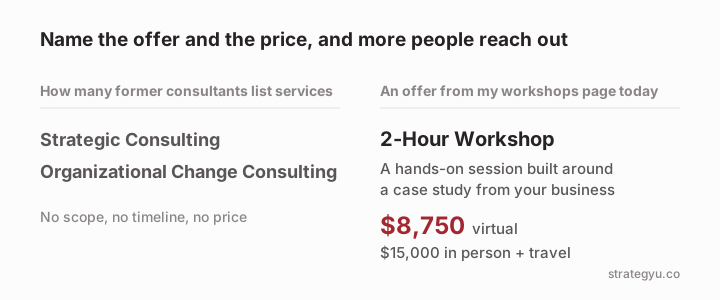
As soon as I added pricing to my site, I immediately noticed a dramatic increase in inbound requests. This is something I wish I knew earlier and I think more freelancers should consider. There are likely a lot of people that don’t reach out for help because they either don’t want to go through the pricing dance or simply just want to know what something costs.
5. Make a credentials and offerings deck
In the same 2022 post, I wrote about how former consultants describe their services:
Many former consultants take a similar approach and will advertise things like “Strategic Consulting” or “Organizational Change Consulting” as a service on their sites. I’ve increasingly come to think that this is a bad approach and the more clear and direct I’ve been in communicating my services, and price, the more people have reached out to me.
When I started, I made a simple page of the ways people could work with me. Today I’d put the same thing in a short deck: the services you offer, what makes you different, and how you work. I made a free credentials and offerings deck you can start from, in four styles, with an AI prompt that interviews you and fills it in.
For the thinking behind your offerings, Jessica Lackey’s Leaving the Casino: Stop Betting on Tactics and Start Building a Business that Works is very good. As I wrote in my review:
There is a lot written on how to build a startup, but not enough written on how to build a solopreneur business. … Luckily, Jessica Lackey’s new book and workbook, Leaving the Casino, offers an absurdly useful guide on how to think through building a business on your own. What made it great, something I’m excited to recommend, is that it goes beyond tactics and pushes people to think through prompts, frameworks, and a well-thought-out process to go much deeper, focusing on the foundation level of your business.
I also talked with Jessica about the book in How To Leave The “Casino”.
6. Decide how you’ll price before your first call
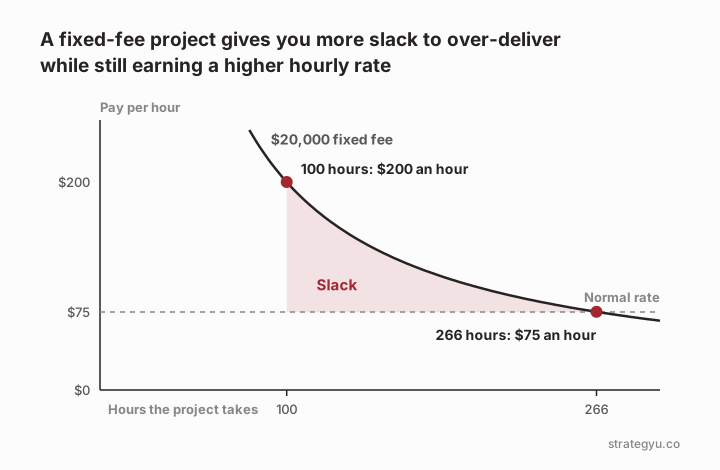
Start from the income you need, then work out the lowest rate you’ll accept. I wrote about time-based, fixed-fee, and productized pricing separately, and about how full-time work led me to sell my time too cheap.
Settle this before you’re on a call, because fear sets the price otherwise. Two years in, I wrote about a project from earlier that year:
While this experience helped me cover the bills, I probably took the project because I was afraid of an extended period of non-work. This led me to underprice it and be a bit too optimistic about the complexity of the work. Lessons learned.
My approach since then, from my 2022 income report:
My general pricing approach, especially for corporate stuff, is “price high or free” but I usually start lower and raise prices as I become more confident about the offer.
Asking for more can work faster than you expect. In The Pathless Path, I wrote about a recruiting firm that called with a training project a week before I left for Asia:
I decided to come up with terms that would make me say “hell yes!” if they agreed. I would work on the job for 10–15 hours a week, for double the rate I had been charging other clients, and I would do it from Asia. I expected them to quickly reject this, but to my surprise, they said yes within an hour of sending my proposal.
For more on pricing, Austin L. Church’s Free Money: Nine Counterintuitive Moves for Life-Changing Freelance Income is very good. Church calls it “a pricing and money mindset guide for freelancers and consultants.”
Phase 4: Land your first clients

As you begin this new chapter in your career, you will undoubtedly make many mistakes and have to shift your focus, your efforts and re-assess how you plan to live your life. Some of the best advice I’ve received or put into place in my own life is below:
1. Share broadly
Remember that list of supporters you put together? You now want to send them an update and let them know what you are up to! Sending individual e-mails is best, but if you want to send a mass update that’s fine too! At the beginning of my journey, I sent about 25–30 e-mails to strong connections telling them what I was up to and thanking them for their support over the years. Don’t paralyze action here by thinking people are not interested in your journey. People love stories. Just think about when people would write exit e-mails in consulting, you always wanted to see where people were headed, right?
Looking back, those first months were what I later called freelance mode:
I reached out to everyone I knew and told everyone I was ready, willing, and able to do projects. This is a necessary step if you want to be a freelancer but can be hard because it’s tempting to hedge the insecurity of a new path by continuing to look for jobs.
2. Continuously engage with your network & add value
I’ve always enjoyed connecting with different people and learning from them. I’ve also always had fun helping others out with their careers, so reaching out to my network is not something that was unnatural to me. Different things I’ve done over the years are to share interesting articles, ask people to connect over coffee, reach out to friends who are doing interesting things with genuine curiosity or reach out to old colleagues to ask how their life is.
3. Find niche consulting firms
There are hundreds of small consulting firms who can not commit to hiring large numbers of people every year like the big consulting firms. Working with freelancers is often a win-win situation for them to work with highly-skilled consultants without having to risk committing long-term to a salaried position. I reached out to a number of small firms doing work in the space I am excited about and try to stay on their radar about potential collaboration opportunities.
This turned into my niche. In 2021, I wrote:
The kind of work I’m talking about in stage three that I’ve found has been working with small and medium-sized professional services firms. This has emerged organically based on some previous project work (I’ve now worked with 4-5 firms like this) and also as higher level work born out of my StrategyU courses.
As I put it a few months later, “It’s clear now that serving this niche was possible but like many things - only clear upon reflection.”
4. Write
Writing is something that every freelancer should be doing. It’s a great way to put your perspectives and passions into the world and for people to start seeing you as a go-to person within a specific space. I enjoy writing because I love the process of getting better at something (always room for improvement in writing!) and it helps me make sense of the world. My Quora answers about consulting tools in 2014 eventually became this site. By 2022, my client work came from people who found my writing and videos. In my 2022 annual review, I wrote, “The crazy thing is that I rely 100% on inbound requests from clients via YouTube and SEO and send everyone the same standardized offer.” I’ve made some great connections over the years from people that shared my interests and reached out after I wrote an article.
Phase 5: Do the work and choose what’s next

1. Write it down for the client
Almost everything I share with clients is a structured document. My proposals start with my read of the client’s situation, written as a few clear takeaways, and the questions we need to answer are sorted so they’re MECE. During a project, I send short check-in documents that go back to the problem, show where we are, and list what I need from the client. I wrote up what goes in a proposal and a check-in separately.
2. Follow your excitement and look for opportunities everywhere
One of the unexpected benefits I’ve experienced from taking the leap to become a freelancer is that work is no longer a zero-sum game. Instead of being locked-in to full-time employment, there are many more models including working remotely, working part-time and one-time teaching, speaking or facilitating gigs. I see some of my free time as an opportunity to work on fun projects, learn new skills, focus on volunteering or giving back through mentoring or as a way to reach out to others and offer my support. When I see someone doing something that inspires me, I now think about how I can reach out to them and potentially start a dialogue towards working together.
3. Be ready to say yes!
You need to be ready to move quickly and jump on opportunities. In the freelance world, things can move a lot faster than getting a traditional job. One of my first gigs got started about 10 days after an initial conversation. You often may receive e-mails from staffing organizations seeing if you are available within the same week. You need to create enough flexibility in your life such that when the opportunities can arise, you are ready to say yes!
I’ve signed and delivered projects within a week, and others took more than a year before we actually kicked off.
4. Say no
This was one piece of advice I got from several freelancers — think about the projects you do not want to do. From my first month of trying to find work, I definitely felt myself feeling a bit insecure about not finding work yet but remained committed to not accepting work just for the sake of it. In our culture, it is hard to avoid the draw to remain “productive” and work for the sake of work, but I think there is something powerful in saying no to something okay to create the space to say yes to something awesome.
I’d add one caveat for your first year. As I wrote in 2021, “There does seem to be an inevitable initial period where people need to take projects that aren’t perfect as a way of slowly figuring out what not to do.”
After that, it helps to have a test. In 2020, I wrote, “If I am taking work because I’m worried about money, I’m probably not seeing it clearly.” These are the two questions I ask before taking new work:
- Rate it 1-10 without picking 7. If it is an 8+, do the project
- How much would I pay to be able to work on this project?
5. Get ready to explain yourself
Since you are going off the traditional path, expect many people to ask questions about what you are doing. I’ve noticed that even if you explain the freelance world to them, a lot of people still look at setting up your own company through a startup lens. People ask me how many people I plan to hire, how big I plan to be and what my business plan is. For me, the answers to these have more to do with the type of life I am designing rather than becoming richer, bigger or more powerful. Given that this is a bit different, I’ve found that some people get a bit defensive, so I try to make it clear that this is what works for me!
A few years later, I wrote a reminder to myself as much as anyone: “You are a human playing the role of a freelance consultant. Always remember that and your game will be a little more fun.”
Nine years in, freelancing is one of several ways I make money
Freelancing turned out to be a first stop. In Good Work, I wrote about where I was nine months in:
Nine months into self-employment, I had landed four different projects and proved to myself that I could “make it” working on my own. But I had a problem: those projects were the same kind I had done in my consulting career, and as my financial anxiety diminished, I discovered that I didn’t actually want to build a life around this kind of work.
I kept a smaller version of it. In 2025, I wrote, “I’ve realized that having a ‘part-time gig’ is still a cheat code for taking risks and fully unleashing my creative work (this returned to a majority of my income in 2024).”
The work takes less time without a firm around it. In The Pathless Path, I wrote about the surprise of doing the same work on my own:
With freelancing, I was competing on the quality of my ideas and my ability to do good work for clients. A lot of former consultants who become freelancers are surprised at how much less time it takes to do the same work. This is not because it’s any easier. In fact, it’s a lot harder without the support of an entire firm’s resources. It’s just that there are no longer hundreds of different people you need to impress.
In 2021, I called working directly with the leaders of organizations “one of the most underrated things about freelancing.”
Your income will likely drift back toward what you earned before. Eight years in, I wrote:
I’ve noticed on my path and observing others that there is a gravitational quality to money. Within 3-5 years, many self-employed people seem to end up earning a remarkably similar income to their former incomes.
The early years were the hard part for me. After I stepped back from freelance work to write and move to Asia, my income “dipped for two years.”
Packages made client work fit my life. By 2025, I’d done one consulting project in three years. The rest of my client work was workshops, sold as a fixed offer. In my 2022 annual review, I wrote:
After packaging the workshops and selling them as a clear offer (I do these starting at $6,000 for one-off trainings and now $25,000 for a four-week offering), I got a lot more interest. I was able to raise prices and position myself as a unique provider in the space.
A lot of the consulting work I do now revolves around training and facilitation. With one client, I’m helping their team learn strategy consulting skills, and around that we’re having broader conversations about talent strategy, AI strategy, and more.
Remote work helped. In 2020, I tried and failed to land clients for remote training. As I wrote in 2022, “In 2021, companies started to see virtual training and learning as a real option.”
AI takes over the busywork. In February 2025, I wrote:
Looking back on my consulting career, it’s kind of funny to think about how much low-skill admin work is being done by highly paid people: taking notes, cleaning and reorganizing data, reformatting and moving things between documents. A lot of this has already been replaced by LLMs or will soon.
A few months later, I added, “I was once a highly paid consultant who would sit on video interviews and take detailed, verbatim notes. This is done 100% by AI now.”
Check Out The Course
Since 2017, I’ve been collecting the lessons I’ve learned as a freelancer, which includes case studies, how-to’s, templates and more
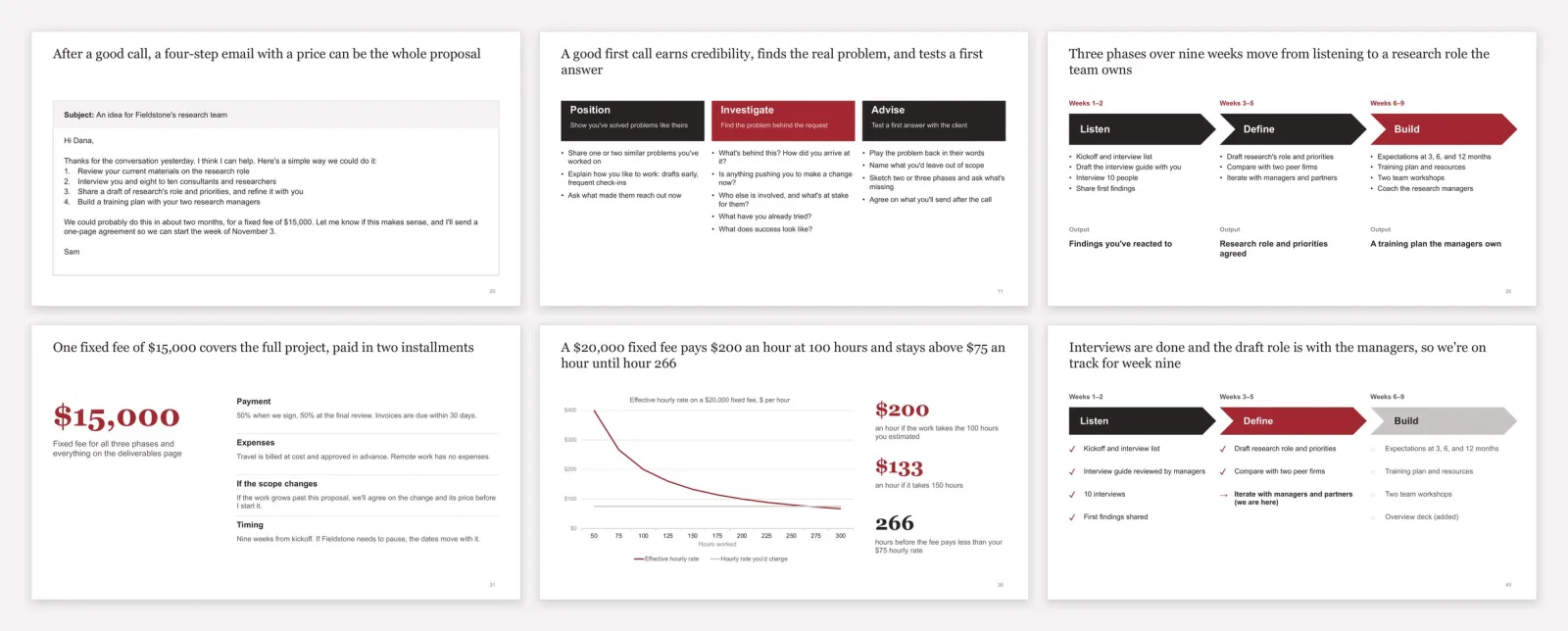
The templates follow one sample project from the first call to the final deliverables, and the pricing calculator is free to try.
The course
Think Like a Strategy Consultant
Structured problem solving, MECE, the Pyramid Principle, and slides that make a point, in one self-paced video course. 1,500+ students in 65+ countries.
Or 2 payments of $398.
Try the free pricing calculator from The Art of Strategic Freelancing →Free
Start with the email course
Six short lessons on consulting fundamentals, one a day.
Get the free credentials and offerings deck for freelancers →